Category Archives: teaching

Analyzing Mistakes

My 9th graders have been learning right triangle trigonometry. We decided to include this topic in the 9th grade math curriculum because they are also taking physics. An understanding of trig will help with analyzing two dimensional motion and also with analyzing forces.

So, we did a bunch of problems and they mostly got it. But not all of them and not all the time. I used Kelly O’Shea’s Whiteboarding with Mistakes idea and had them produce solutions with common mistakes that students might make when solving these kinds of problems. Then the other groups had to identify the mistakes in a given solution. It led to some interesting discussion.

“Why would you want us to deliberately make mistakes?”

What a great question, I responded. Why do you think? Here’s a sampling of their responses:

  • To make us aware of mistakes that we can make.
  • To make us pay closer attention to our work.
  • To have fun.
  • To challenge each other.
  • To teach us how to analyze work.
  • Because without mistakes there can be no learning.

A little side note.

The 9th graders at my school also take an engineering class where they practice and practice the engineering design cycle. They identify a problem, design a solution, test it out, see where it fails, make improvements, and begin again. The teacher is very clear about learning from mistakes. Apparently, that message is being heard as evidenced by the last comment.

“Because without mistakes there can be no learning.”

I’m not sure that I agree with that exactly; I don’t think that mistakes always have to present for learning to happen). I do know that I tend to learn more from situations that give me unexpected results. But the better thing here seems to be that we are helping our students to understand that their work doesn’t have to be perfect the first time. They are kind and curious and smart – and not afraid of making mistakes.
Leave a comment

Filed under Baxter, teaching

Function Carnival

I haven’t been doing a good job posting this year. Something awesome happens in class and I think, “I have to write that up.” Then I get home, and start planning the next few lessons, and I forget all about the awesomeness. It’s been a busy year.

This morning, on CBS Sunday Morning, I learned about a truly extraordinary man, Jim O’Connor, a high school math teacher who volunteers his time at the local Children’s Hospital. What made me sad, though, was his comment, “It drives me crazy when people say that school should be fun. I mean it’s nice if it could be, but you can’t make school fun.” Watch the video. Mr O’Connor really is an amazing man. I just think that it might be time for him to retire from teaching.

I mean, if learning math can’t be fun, then why should anyone consider doing it? Kids and their parents already think that learning math is a drag, so shouldn’t we math teachers be working hard to change that thinking, not perpetuate it?

I’d like to think that my students have had fun learning this year. From dissecting chocolate chip cookies to writing graphing stories to rolling balls down ramps, they’ve collected and analyzed data and created function models. They’ve studied some statistics and some functions (linear and non-linear) and now we’re working on right triangle trigonometry. With 9th graders. I’ve worked hard to make learning fun and challenging.

Thankfully, others are also working hard to make school mathematics not only interesting and fun, but helpful for us teachers to diagnose student difficulties. Take the Function Carnival currently under development by Christopher Danielson, Dan Meyer, and Desmos. Honestly, I don’t know how they do it over there at Desmos, but these little animations will tell me more about what my students understand about functions than anything I could have come up with. And the beautiful thing is that they’re engaging for physics, too. That’s awesome for me and my students because at Baxter Academy, my 9th graders are also learning physics. Imagine my glee at learning about this interesting new tool. I will definitely have them exploring (in a few weeks) and sharing the results with my physics teacher colleagues.

In response to suggestions from the many commenters to Dan’s post, the Desmos team got busy creating more scenarios, including graphing velocity vs. time along with height vs. time. I’m looking forward to these new situations being included in the current Function Carnival site. Maybe they’ll be ready when I need them in a few weeks. It will also be fun to have my students attempt these graphs before we go off to Physics Fun Day in May.

Here are a few more challenges in development:

Try them out. Give feedback. Encourage your students to have fun while they learn.

3 Comments

Filed under teaching, technology

Spreadsheets – Part 2

As a reminder, here’s the original project descriptor.

Here’s a report from one pair of students.

Mistakes made: Originally we had started out with a more expensive, brand new car. Our budget was about $100 a month to put towards a car, so it would have taken us 20 years to pay off the car, which is unreasonable. We had to downsize and settle for a less luxurious car, but one that still met almost all of our standards.

Assumptions:

      • 4 weeks is a month.
      • We have enough money saved for the down payment.
      • We take 10 years to pay off the loan
      • annual rate of 2.29% for loan

Mid-size Sedan

2. We have $100 left for a monthly car payment. Income- expenses. 3400-3300=100

3. Typically for a down-payment you would need about 11% of what the car is worth. So for our car that is worth $11,000 we have about $1,210 saved for the downpayment.

4. The requirements that our car has to meet are 4 door, 30 mpg, mid-size, seats 5.

5. We would want our car to have a working air conditioner, heat, sunroof and radio.

6. We decided to get a used Mazda6i Touring for $11,000 but with 10% off it would cost $9,900.

7. We would need to borrow $9,900 and we would get this money by taking out a loan with Bank of America.

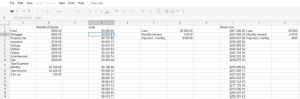
8. (On Spreadsheet)

spreadsheet

9. Our dream car was originally a new fully equipped midsize sedan with a sunroof, but after we found that with our budget of $100 dollars a month, it would take 20 years to pay off. So we decided to get a used car. Mazda6 i Touring which still had air conditioning and heat but did not have a sunroof sadly. This car still meets most of our requirements and was much more affordable so we would be able to pay it off in 10 years.

10. Like we said in number 9, one of our problems before was a 20 year long loan. We fixed this problem by selecting a cheaper used car to buy. If the payment stays the same ($100) and the down payment is the same (11%) then the more expensive the car, the longer the duration of a loan.

https://www.google.com/search?q=Stretch+hummer+limo&rlz=1C1CHFA_enUS497US497&sugexp

11. Our dream car is a stretch hummer limo. The cost of this car brand new is $300,000 after the down payment of 11% costs $267,000. This car would be impossible for us to pay off because the interest that we would have to pay is more than we make monthly so the payment would keep increasing and we would never be able to pay it off.

12. To pay off our dream car in six years we would have to earn about $7320 a month. So subtracting expenses that leaves about $4025 a month to put into the dream car, which will pay it off in 72 months. Assuming that the interest rate and bargaining rate are the same.

What I like about this solution:

  • They stated their assumptions.
  • They made decisions.
  • They made adjustments.
  • They analyzed their results.
  • They dreamed big.
  • They used absolute addressing as part of their spreadsheet formulas.
  • They knew the difference between an annual interest rate and a monthly interest rate.
  • They understood that if their payment doesn’t even cover the monthly interest, they’ll never pay off the loan.

There were several solutions like this one. Not enough, though. Something to think about next year.

Leave a comment

Filed under problem solving, teaching, technology

Authentic Assessment?

My junior level math classes have begun working on a project called Buying a Car. For the past few classes we’ve been problem solving using spreadsheets. They’ve been working in teams, using Google spreadsheets to solve problems like this and this (which I adapted from our Core-Plus Mathematics text). My teaching colleague and I decided to jump into this spreadsheet mini-unit before our students had to turn in their laptops for the year. (We are a one-to-one school.)

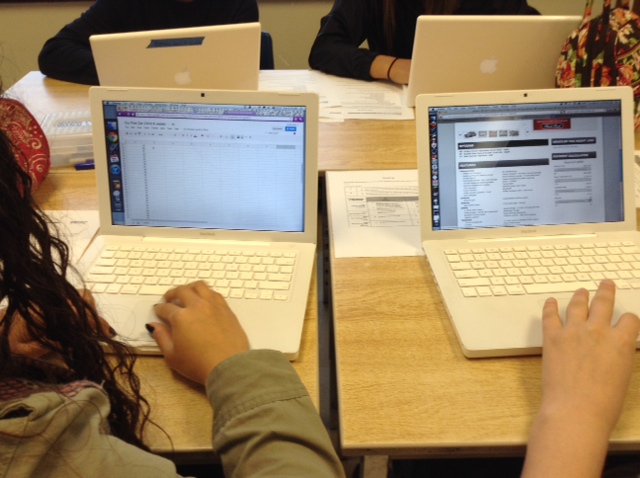
Here are some pictures of my students hard at work.

photo7  photo6

photo3

photo2

Some things I heard as the students were working:

  • Oh, so the bank pays for the car and then you pay the bank. I get it now!
  • How much does gas cost right now?
  • Where’s the best place to get the loan from? What’s the lowest interest rate we can get?
  • Are we going to buy that truck? What’s the gas mileage on it?
  • How do we figure out the payment? What did we do before?
  • So we have to add the interest and then subtract the payment.
  • We can cut back on the money for entertainment. We can be cheap. There’s only two of us, we don’t need that much food. It’s not like we’re feeding any children.
  • How do we determine how much for a downpayment?
  • Can we afford a monthly payment of $875?

Here’s what I really like about this assessment (having never done it before):

  • There is a high degree of choice.
  • There isn’t a definitive solution.
  • Students have to make (and state) some assumptions in order to solve the problem.
  • They have to think about lots of things that go into a household budget and buying a car.
  • Students working together and helping each other to succeed.

What I’m not so sure about:

  • The quality of their results.
  • If they’ll really apply what they’ve learned during the past 4 classes learning about spreadsheets.
  • How much understanding they’ll walk away with.

It will be interesting to see what they produce as a result.

Leave a comment

Filed under problem solving, teaching, technology

Listening to Students

During the past few weeks, I’ve had a teaching intern in my class. This has given me the opportunity to observe and listen to how my students talk about math. It has been a real gift to be able to listen. What have I heard?

First, let me say that students in my classroom typically work in groups. They are accustomed to working as teams and talking about math. I just usually don’t get a chance to listen to them all.

Screen shot 2013-04-11 at 2.43.21 PM

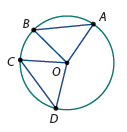
Two of my classes have begun a short unit on circles and properties of circles. They were investigating the relationship between central angles and their corresponding chords. The problem in the book asked them to prove that if AB = CD, then the measures of arcs AB and CD are also equal. Keep in mind that we use an integrated curriculum, so the last time kids had to prove anything geometric was in January. They were using whiteboards and drawing diagrams and pointing and talking math. While they worked the problem, I walked around and listened to what they had to say.

Here’s a sample from one group:

M: Oh, wait, those sides are all equal.
E: Why?
M: They’re all radiuses.
K: Okay. So if those are all equal and these two are equal, then the triangles are congruent from side-side-side.
M: Right.
E: But how does that help us prove that the arcs are equal?
M: These two central angles are the same because the triangles are congruent.
E: And if the central angles are the same then the arcs are the same.
K: Right. Good.

This was a typical interaction for this class. A couple of groups needed some teacher questioning to point them in the right direction, but most of them were talking about math and reasoning their way through the problem. Isn’t that the ultimate goal?

Leave a comment

Filed under teaching

Ask different questions

Rather than assess whether my students can do matrix multiplication by having them multiply matrices without a calculator, I decided to ask a different question. After all, the point is about understanding and not computation, right? So, instead of giving them a non-calculator section on their quiz, I changed the question:

Given that
\left[  \begin{array} {cc}  5 & 2\\  7 & 3\end{array}  \right]  \left[  \begin{array} {cc}  1 & -4\\  -6 & 9\end{array}  \right]=  \left[  \begin{array} {cc}  -7 & -2\\  -11 & -1\end{array}  \right]

explain the calculation that gives the entry in the first row, second column of the product matrix.

Leave a comment

Filed under teaching, technology

Round Robin Review

I’ve used whiteboards for math instruction for many years now, but the other day I learned something new on Kelly O’Shea’s blog post about whiteboard speed dating. Really cool idea. So, I’ve been thinking about how I can implement that idea in my classroom which, at times, has as many as 25 students in it. I don’t have the space to have 12 or 13 pairs of students (even my smaller classes would need 10 pairs). I also noticed Kelly’s comment about one group erasing what another had put on the board and just starting over because they couldn’t understand what the previous group had done. So this really got me thinking. My modification of whiteboard speed dating became the round robin review.

I had my students partner up creating 7 groups of two and one group of three. I used four review problems about creating and solving systems of equations that I modified from our text. Each of the four problems was given initially to two groups. They were given some time to begin solving the problem on chart paper. Then, after about ten minutes, we swapped the chart papers. This gave each group a new problem to make sense of and another group’s work to review, correct, or continue. Then we swapped once more. Finally, each group got their original paper back. The two groups with the same original problem teamed up to compare their final results, discuss any issues, corrections, or comments that were made.

When we had finished the entire process I asked my students how it worked for them. The responses were generally positive. They appreciated the opportunity to review in a different way. One student said that “it really helped trying to look for mistakes made by others because that would help her know what to look for in her own work.” Another student said that “it made him focus on communication.”

My observations and thoughts

I had one group doing all the work in the first round on notebook paper – and they were working individually – so they ended up with nothing on the chart paper. So, the empty chart paper with the other notes was passed onto the next group, who started solving from the beginning. I need to keep working on getting them past that idea that chart paper is for final drafts only – although I tried to make clear at the beginning that the chart paper was for doing the work. It was not something that was going to be framed and hung on the wall. They do seem to understand this with whiteboards.

I had a couple of groups “review” worked that clearly had mistakes in it, but made no comments or corrections. This indicates that these students are not invested in others’ work the way they are in their own. How do I change that thinking? Maybe that’s where Kelly’s mixing of the teams comes in. I’ll have to give those logistics more thought. How do I arrange the tables in my classroom to accommodate the complicated dance involving eighteen students?

I’m definitely going to try this again.

Leave a comment

Filed under teaching

Best. Class. Ever.

Once the blogger challenge ended and school really got going, I had little time for writing things down. Too bad, really, because some cool things happen in my classes and I’d like to record them. Take this class, probably last Thursday. My 10th graders are learning about matrices – what they are, how you can use them to organize information, how to do mathematical operations with them, and their properties and applications. The material all comes from our awesome textbook, Core-Plus Mathematics; the instruction comes from me, the person with the expertise.

Anyway, there we were, struggling with matrix multiplication. And, yes, I know that calculators do the multiplication. And, yes, my students have since learned how to use the technology. But, as I explained to my students, understanding how to multiply matrices allows them to be able to make sense of the results that the calculator gives them. So, they were struggling with the process. I gave them an example to work on in their groups. (Yes, my students work in groups.) They were to put their solutions on white boards. (Yes, we use group white boards.) Let’s say these were the matrices in question (the actual matrices aren’t important):

[  \begin{array}{ccc}  2 & 3 & 1 \end{array}  ]   \left[  \begin{array}{cc}  1 & 2\\  0 & 6\\  4 & -3 \end{array}  \right]  

When the groups were finished multiplying these two matrices, they put their white boards up front. Two boards had

\left[  \begin{array}{cc}  6 \\  18\\  -1\end{array}  \right]  

and the other three boards had

\left[  \begin{array}{cc}  -2 & 25 \end{array}  \right]  

This was going to be interesting. Whenever we use white boards in class, the first question is, “What do you notice?” I don’t even have to ask it anymore. On this particular day, some students were saying that two groups had the wrong answer while other students were claiming that three groups had the wrong answer. I asked, “How do you know that any group has the right answer?”

This is where the magic began. One student said, “Can I explain how we did ours?” Like I’m going to say no to that. Then he asked, “Can I go to the board?” Of course. As he was explaining his group’s thinking, other students were clamoring to respond. Immediately after he was finished, another student said, “I have a rebuttal.” Very quickly, my students were debating the correct way to multiply matrices. Debating! Respectfully! In fact, one student explained her group’s process

Once everyone was convinced that three groups had found the correct solution, we reflected on what had just happened. We learned

  • interesting things can happen when we disagree
  • we can disagree respectfully
  • the teacher doesn’t have to tell us if we’re right, we can reason through it ourselves
  • time flies when you’re having fun

That’s right. My students said that the class was fun!

That was the first day of matrix multiplication. Do they continue to have struggles? Of course, but we chip away at it a little bit every day.

Leave a comment

Filed under teaching

It’s about problem solving

I began this year by having my students tackle one of Dan Meyer‘s 3-act math tasks. In fact, all of the teachers in my department did. We wanted to pick a problem that wasn’t too difficult mathematically so we could focus on the problem solving process. We picked “The Incredible Shrinking Dollar” and we had all of our students solving the problem on day 1. I teach one 10th grade integrated math class, two 11th grade integrated math classes, and one 12th grade pre-calculus class. Here’s what happened:

  • Watched the video a couple of times.
  • Asked the question, “How big is the dollar after 2 (or 3) shrinks?” (The class determined how many times Dan shrank the dollar in the video.) Groups worked and presented their process on white boards.
  • Some groups interpreted “big” as referring to side dimensions, while other groups determined that “big” meant area. Several groups correctly calculated the new dimensions (using four different strategies). One group determined that losing 25% two times meant that the dollar would now be 50% of it’s original size. What a fabulous opportunity to address this common misconception! Groups interpreting “big” as area were split depending on how they chose to calculate the reduction. Some shrunk the area (typically incorrectly), while others shrunk the dimensions and then calculated the area. The differences in these results made for some very rich discussion.
  • Asked the questions, “How big is the dollar after Dan shrinks it 9 times? Draw your guess. Will you still be able to see it?” This time all groups made correct calculations. Some of the “area” groups multiplied the original area by 0.75^18, while others used (0.75^2)^9. Cool, huh? But, I wasn’t convinced that they saw that these dimensions weren’t even close to the estimated pictures they had drawn. In fact, several drawings suggested that the groups thought that the dollar would be 1/9th the size in area. So I gave them rulers and made them draw their results. This gave us another great opportunity to address misconceptions: units were in millimeters (“which side is millimeters”), is 1/9th of the dollar (in area) the same as shrinking it 9 times, and so on.
  • Asked the question, “How many times does Dan have to copy the dollar for it to become invisible?” A couple of groups thought this was a trick question: “The dollar will never be invisible – it will always exist.” Other’s asked, “What do you mean by invisible?” I turned the question back around to them so they had to define the term and then answer the question accordingly. One group looked up “too small to see with the naked eye” while others made more arbitrary decisions. We had a great discussion about how different assumptions can lead to different, valid results.
  • The pre-calculus class had to use a different problem because one student had already solved the dollar problem. I chose a different problem on the fly. I looked down Dan’s list of problems and Coke vs Sprite caught my eye. This was true problem solving for this class. The students looked to me for help, but I hadn’t done the problem, either. All I could do was point them to the problem solving guidance that our department created. The problem poses a very simple question that my students spent 75 minutes trying to answer. The best part of the whole process was that they didn’t believe their results – because the results didn’t agree with their initial prediction. How awesome is that?

I’m really happy that we decided to start the year this way. It really set the tone:

  • Different approaches can lead to equivalent results
  • Different assumptions can lead to equally valid results
  • Equally valid doesn’t necessarily mean the same
  • We can learn from everyone and from everyone’s mistakes
  • Mistakes are opportunities for discussion and clarification
  • Initial thinking can be wrong; you have to do the math to find out

What a terrific way to start the year!

3 Comments

Filed under teaching

“I can’t do math, either.” – a parent

Nothing burns me more than those words. Seriously, would that same parent ever admit, “I can’t read, either”? Of course, not. As a society, we seem to accept a self-proclaimed inability to “do math” as a badge of honor – something to wear with pride. Often, the parent making that statement runs a business. Does that mean that running a business does not require math? Of course not. So where is the disconnect? Maybe the parent is intimidated by high school math teachers. Maybe that parent thinks that “doing math” means “doing algebra” or “doing geometry” or whatever it was he did in high school.

What to do in that situation? First, smile. Then, take a breath. Then ask a few questions like

  • What kind of math do you use in your daily life?
  • Do you mean that you struggled in high school? What do you think contributed to your struggle?
  • What do you think it means to “do math”?

Usually, opening the lines of communication leads to understanding. The parent’s claim, “I can’t do math, either” could mean any number of things:

  • I didn’t get good grades in my high school math classes
  • I can’t help my child with her homework
  • I struggled with algebra (or some other topic)

Through conversation, I often help the parent understand that he probably can “do math” and “does math” every day. Conversation also allows me to explain that while we are teaching some specific skills and content, we also teach communication, collaboration, reasoning, and problem solving. And those are skills that kids can take with them anywhere – and do math.

4 Comments

Filed under teaching