Problem Solving with Algebra

That’s the name of one of the classes I’m teaching this term. We have trimesters. So each term is 12 weeks long and we have a week of “intersession” in between the terms. Except that this first term is not quite 12 weeks. The expansion area of the building wasn’t quite finished when we started school, so we had some alternative programming called “Baxter Foundations.” It included stuff like my Intro to Spreadsheets workshop. Classes started this week. And one of my classes is called Problem Solving with Algebra. I came up with that name, and I honestly don’t know exactly what it means. I have a rough idea, but it could go in a lot of different directions. Mostly, I want my students (and all the students taking this course) to think and puzzle and use algebra and solve problems.

Then I got an email that Jo Boaler has published a short paper called The Mathematics of Hope. In it she discusses the capacity of the human brain to change, rewire, and grow in a really short time based on challenging learning experiences. We’re not talking about learning experiences that are so challenging that they’re not attainable, but productive struggle. Challenging learning experiences that produce some struggle, but are achievable. The ones that make you feel really good when you solve them. You know the ones I mean.

So I decided to start this class with a bunch of patterns from Fawn Ngyuen‘s website visualpatterns.org. The kids are amazing. They jumped right in. Okay, so I taught most of them last year and they know me and what to expect from me, but seriously. Come up with some kind of formula to represent this pattern. Kinda vague, don’t you think? And I’m pushing them to come up with as many different formulas as they can, and connect those formulas to the visual representation. For example, an observation that each stage adds two cubes to the previous stage would result in a recursive formula like: C(n) = C(n-1) + 2 when C(1) = 1 (which is a recursive formula for pattern #1).

On Tuesday, different groups of students were assigned different patterns. Wednesday, each group presented what they were able to figure out. Some had really great explicit formulas, while others had really great recursive formulas. A few had both. Most were stumped at creating an explicit formula for pattern #5, pattern #7, and pattern #8.

Tuesday night, I received this email from Sam, a student:

“After staring at the problem for 2 hours, (5:45 to 7:45) and scribbling across the paper as well as two of my notebook pages, I am still unable to find a explicit equation. Then, reading the directions, I realized that the way they are worded allows the possibility of no explicit equation, as well as the fact that I only had to come up with equations as I can find. So after 2 hours, several google searches, lots of experimentation and angry muttering, I decided I have all that I can muster, and must ask you in the morning.”

I left them with the challenge to find an explicit formula related to one of these patterns. Their choice. Just put some thought into it before we meet again on Monday. Wednesday night, Sam sent me this followup email:

“After another hour at work, I found the explicit formula. I realized that the equation was quadratic, not exponential, and youtubed a how-to for quadratic formulas from tables. I kid you not, the man said the word “rectangle” and from that, I solved the problem. Then I watched the video through and took quick notes for future reference.”

Then, Dan Meyer posts this: Real work vs. Real world. Makes me think – as always. What am I asking of my students? This is real work – they are engaged and they are thinking. Sam, and the others, were not going to be defeated by a visual pattern. The fact that they are working in a “fake world” doesn’t matter.

1 Comment

Filed under Baxter, problem solving, teaching

The Power of Interesting Questions

Today I led two groups of students through an introduction to spreadsheets as part of our Baxter Foundations workshops. Our framing question was, “How much is that Starbucks habit costing you?” Many students, of course, said $0, but we widened the question to include other vices, like Monster drinks, Red Bull, going across the street to Portland Pie every day, or down the street to Five Guys for lunch. And we broadened the question to, “What if you put your money into a retirement fund instead?” To make this real for my students, my friend Tracy admitted to her Starbucks habit and offered to be our real case study.

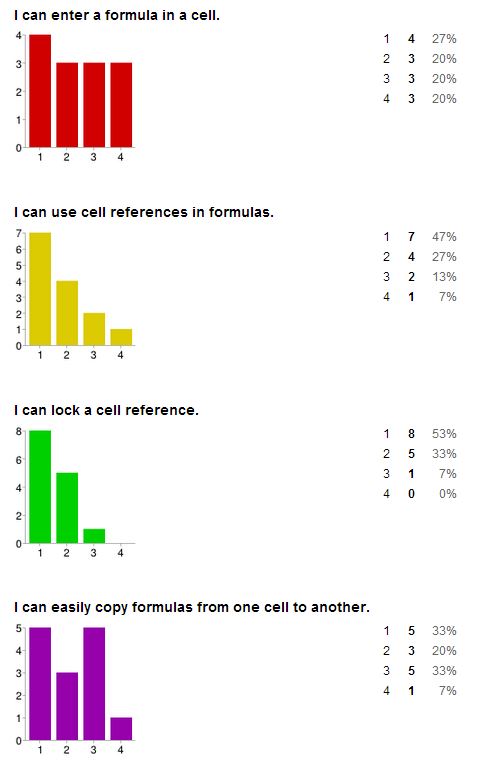
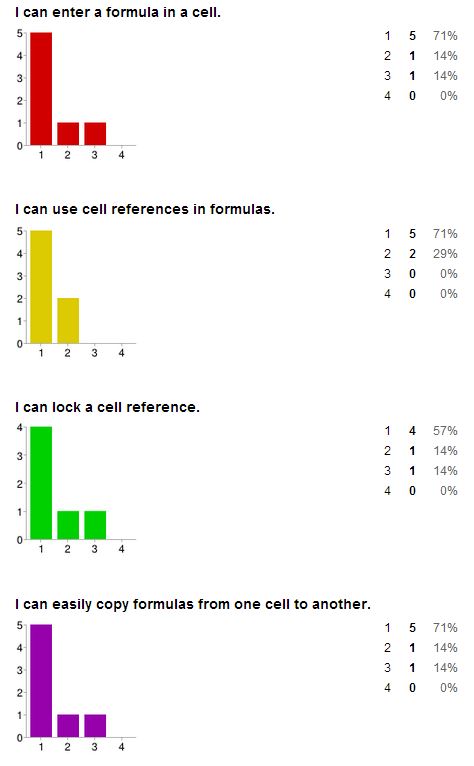
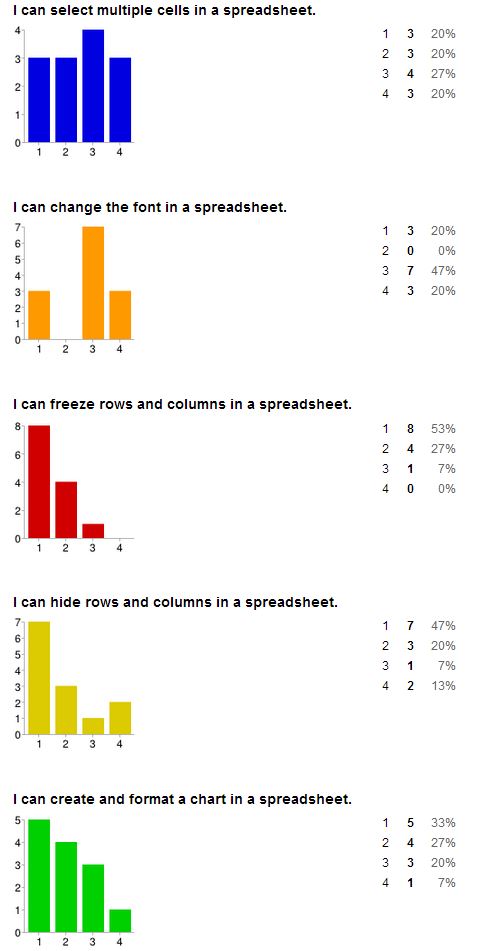
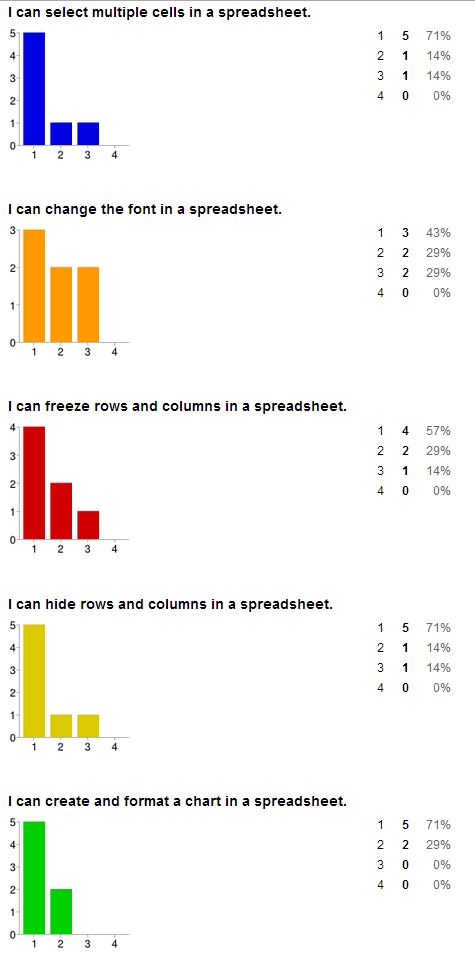
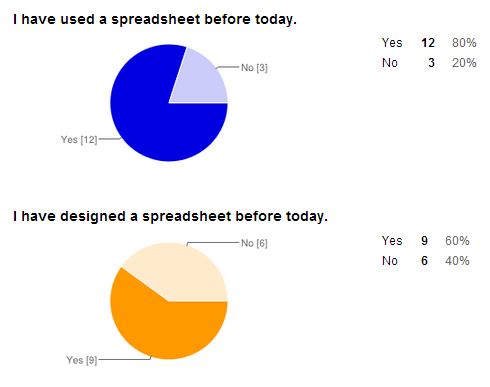
Before we started creating anything, I asked the students to complete this quick survey to figure out what they knew and what they didn’t. Then we looked at the results as a group. Here’s what we found:

Group 1: Mostly sophomores

Group 1: Mostly sophomores

grp2-1

Group 2: All freshmen

grp1-2

Group 1: Mostly sophomores

grp2-2

Group 2: All freshmen

grp1-3

Group 1: Mostly sophomores

grp2-3

Group 2: all freshmen

Clearly, the sophomores were bringing more to the table than the freshmen. After all, they had been instructed in spreadsheets in their engineering class last year, but they were still a bit unsure of what they knew. They thought they probably knew more than they had indicated, but didn’t know what I meant by “cell reference,” for example. And remember, I teach in Maine where 7th graders are given their own digital device. It used to be a laptop, but last year many districts changed to iPads. I would have expected the 9th graders to have had much more experience with spreadsheets, but I’m seeing that the switch to iPads is having an impact on that. Very sad.

I began by explaining the situation: Tracy spends $x each day on her Grande Soy Chai at Starbucks. If we want to figure out how much she spending, and what she could be earning instead, what information do we need? And then I had them brainstorm for a couple of minutes.

Information needed: cost of the drink, how much spent each month, and interest rate for the investment.

We made a few assumptions:

  • Tracy could find a mutual fund, or other investment, that earns an average of 7% annually
  • that she is 25 years from retiring (I don’t actually know this)
  • that the price of coffee would not change over the life of the investments (we knew this was unreasonable)
  • that Tracy would invest the same monthly amount for the life of the investment (also unlikely)

But this is also part of problem solving. Take a few minutes to watch Randall Monroe’s TED Talk and you’ll understand what I mean.

So here’s the spreadsheet that we came up with.

So what did we learn?

  • Tracy spends a lot of money on her Grande Soy Chai. But, it’s possible that the drink adds some value to her life and is worth the price.
  • Investing early and for a long time really can pay off, even if the amount invested isn’t all that much each month.
  • Learning about spreadsheets can be fun if you have an interesting question to answer.

Do I think the students in this 90-minute workshop will remember everything that we discussed? Of course not – I’ve been doing this job way too long to think that. But here’s the beauty of it all – they have their own model to reference, be it Google or Excel, they all created one and can take another look at any time. I heard from another teacher that a couple of his advisory kids started talking about making their own coffee instead. A couple of my advisory students commented on the experience at the end of the day. One said, “It was interesting to see how the numbers involved in the Starbucks added up if invested in a retirement fund. The actual application was nice.” Another said, “The spreadsheet exercise this morning was fun. I think it was the funnest way to learn how to do a spreadsheet I have ever done. So thank you.”

You’re welcome.

1 Comment

Filed under Baxter, problem solving, teaching, technology

Baxter Foundations

We are beginning this year with a week of what we’re calling Baxter Foundations. We realized at some point last year that we should have done more to bring our students together at the beginning of the year. They are coming from 30+ different towns and educational backgrounds. While I completely support and value the time spent building community last week, we could also use some time building that academic foundation and getting out into the community. These are also foundations of our philosophy. Full disclosure: Our Phase 3 renovation of the building isn’t going to be ready to begin classes on Monday, so we find ourselves with this opportunity.

Beginning tomorrow, our students will participate in such varied experiences as going on college visits, listening to an entrepreneur’s journey, seeing a planetarium show, walking the Portland Freedom Trail, watching a film at nearby SPACE Gallery, touring the waste-water treatment plant across the bridge, visiting the Wells Reserve to learn about the environment, and learning about agriculture by working on Wolfe’s Neck Farm. Those who stay in the building will participate in workshops as varied as learning about Flex Friday, understanding rubrics, plagiarism, research strategies, reading strategies, and teen dating violence. Other workshops include introductions to spreadsheets, probeware, and modeling. Some students will participate in some fitness and conditioning while others are working with local experts on creative writing or art. We have a workshop in food chemistry (Is that really food?) and other in project management. 

I’m excited about the opportunity to begin the year this way. It won’t be perfect, but we will take those pieces that worked, fine-tune them, and improve Baxter Foundations for next year. After all, that’s what the design process is all about. And that’s what we do at Baxter Academy.

1 Comment

Filed under Baxter

Baxter Academy: Year 2 Day 2

This Day 2 was different from last year’s Day 2 – of course. There was no furniture to build, at least not yet. We have more students now. Only 9th & 10th graders were in the building today, but there are still more of them, which is great. Today was about orientation, and reorientation. As with any project, any design challenge, reflecting and improving are important steps. We’ve done that. There are changes to what we plan to do with kids this year. Some rearranging of the schedule, a bit more time with our advisory groups, nothing huge. Our philosophy is still the same: we want our kids to be able to stand up and say what they know and believe. We want them to be fearless, and to learn from mistakes.

Today’s schedule was organized around our advisory groups. We teamed together a 9th grade group with a 10th grade group. Those groups then rotated through a series of presentations about our school: Open Campus, Flex Friday, Baxpectations & Standards Based Grading, Baxtitution, Student Government, and Student Judiciary Board, Mentoring & Advisory, and a slide show of the teachers. All of these presentations were designed by teams of 10th graders, student senators, who had minimal guidance from a faculty member. Was I nervous about what they would say? Sure, I was. Did they do an amazing job? Of course they did. That’s what impressed me the most. Not only did twelve 10th graders agree to put in extra time to create a presentation about a specific topic special about our school, they delivered that information six times and answered countless questions. And the 10th graders in the audience asked great questions, too. It was really a good morning, led by kids. Could it have been better? Sure. That’s the reflection and iteration part. Next year it will be slightly different, slightly tuned, and more effective. But I doubt we will change the overall purpose or how it is student-led. Those six topics were selected by students who spent the last day of school last June brainstorming and designing today’s orientation model.

After lunch, we got outside (another gorgeous Maine day), walked to the Old Port with our 9th grade partners (my advisory group really wanted to get to know them better), learned about next week’s “Baxter Foundations” schedule (more about that next week), and had our own design challenge for “Baxter Swag.” When you work in a school that revolves around problem solving, it’s good to get in as many design challenges as you can.

When I asked my students to sum up their first two days (10th graders do not have school tomorrow), many of them said how great it was to be back in school. Even with the changes (new students, new faculty, new building spaces, moved classrooms). One student said, “All summer, people asked me about Baxter. They know it’s a charter school and they want to know about it. The best way I could sum it up is to tell them that I am excited to come to school every day. I’m so glad to be here.” Ditto that.

Leave a comment

Filed under Baxter

Baxter: Year 2 Begins

This time last year, I began a brand new adventure, a leap of faith, as my principal said recently. I left Poland Regional High School to help start a brand new school in Portland, Maine. A Brand New School. Would it open? Would kids even come? Would we survive year one? Would there be a year two? There were certainly lots of questions, and not many answers. Except, we did open, kids did come (and keep coming), we survived, and there’s a year two. We’ve expanded our faculty to meet the needs of another 100 students. We’ve revamped our schedule and our curriculum. We’ve created a school-wide writing rubric, together, with input from the entire faculty (soon to be approved), that we agree to test out during the fall term. We are moving forward.

Last year, we weren’t sure if the school would open on time. There were issues with building and occupancy permits. We spent our first day team and community building at Fort Williams Park. And by Day Two, we were in the building, putting together our cursed Ikea furniture. But it was an adventure that drew us together as a team and a community. How could we possibly recapture that spirit this time around, when we have a year behind us? After all, we’re not “new” anymore.

Fort Williams worked so well last year, that we’re doing it again, but only with 9th and 10th graders. Two hundred thirty students are too many for Rippleffect to work with all at once, so we’re splitting up. They will have our 9th & 10th graders at Fort Williams Park this Wednesday. They will host the 11th graders on Thursday, using the facilities on Cow Island in Casco Bay. Meanwhile, the 9th & 10th graders will be back at school orienting each other about Baxter Academy, and the ways that our school is different from other public schools. On Friday, those juniors, and some sophomores, will work with the 9th graders as mentors. And there will be furniture building, of course.

I’m excited about how we’ve rearranged our curriculum. We are organizing by trimesters, and we are focusing on being really standards-based. So, we’ve created these 12 week courses, that focus in on specific standards. In math, that means focusing on Algebra or Functions or Statistics or Geometry. Those are the big, reporting standards. There are course standards that are a smaller grain size, like Building Functions or Reasoning with Equations. But this is the exciting part, for me, of continuing to build this school. Figuring out what standards-based, really standards-based, graduation looks like. Not some hybrid of standards, courses, and credits, but standards. It’s a work in progress, like everything, but I’m excited to be teaching courses like Functions for Modeling, Problem Solving with Algebra, Intro to Statistics, Designing Experiments & Studies, and Programming for Beginners. That last one came from our students.

The wrinkle to our beginning school this year is the fact that our basement renovation will not be complete in time for the week that we had planned for classes to begin. But when it’s done, it will give us some really awesome spaces: a fabrications lab, complete with drill presses and table saws and a CNC router and whatever else we can get our hands on, and real science lab with benches and space to conduct experiments, a CAD focused computer lab, and a couple more classrooms.

Rather than see this as a complete setback, it provides us with an opportunity. The opportunity to pull our students together, students who come from 35 different communities, and teach them a few skills. Skills that range from how to get around Portland (so you don’t get lost at lunchtime) to what to know about your laptop and how to organize your Google drive. We have workshops on how to conduct research (it’s more than just Google?) to understanding where food comes from (have you seen Jamie Oliver’s TED Talk?) to learning how to use science probes for collecting data to just a little bit about project management.

Sure, we didn’t plan on two weeks of Baxter Foundations, but we are Innovative and Ethical and see this delay as an opportunity rather than a setback. That’s part of the payoff of taking that leap of faith a year ago. I am constantly reminded that it was the right leap to take.

Leave a comment

Filed under Baxter

Analyzing Mistakes

My 9th graders have been learning right triangle trigonometry. We decided to include this topic in the 9th grade math curriculum because they are also taking physics. An understanding of trig will help with analyzing two dimensional motion and also with analyzing forces.

So, we did a bunch of problems and they mostly got it. But not all of them and not all the time. I used Kelly O’Shea’s Whiteboarding with Mistakes idea and had them produce solutions with common mistakes that students might make when solving these kinds of problems. Then the other groups had to identify the mistakes in a given solution. It led to some interesting discussion.

“Why would you want us to deliberately make mistakes?”

What a great question, I responded. Why do you think? Here’s a sampling of their responses:

  • To make us aware of mistakes that we can make.
  • To make us pay closer attention to our work.
  • To have fun.
  • To challenge each other.
  • To teach us how to analyze work.
  • Because without mistakes there can be no learning.

A little side note.

The 9th graders at my school also take an engineering class where they practice and practice the engineering design cycle. They identify a problem, design a solution, test it out, see where it fails, make improvements, and begin again. The teacher is very clear about learning from mistakes. Apparently, that message is being heard as evidenced by the last comment.

“Because without mistakes there can be no learning.”

I’m not sure that I agree with that exactly; I don’t think that mistakes always have to present for learning to happen). I do know that I tend to learn more from situations that give me unexpected results. But the better thing here seems to be that we are helping our students to understand that their work doesn’t have to be perfect the first time. They are kind and curious and smart – and not afraid of making mistakes.

Leave a comment

Filed under Baxter, teaching

Function Carnival

I haven’t been doing a good job posting this year. Something awesome happens in class and I think, “I have to write that up.” Then I get home, and start planning the next few lessons, and I forget all about the awesomeness. It’s been a busy year.

This morning, on CBS Sunday Morning, I learned about a truly extraordinary man, Jim O’Connor, a high school math teacher who volunteers his time at the local Children’s Hospital. What made me sad, though, was his comment, “It drives me crazy when people say that school should be fun. I mean it’s nice if it could be, but you can’t make school fun.” Watch the video. Mr O’Connor really is an amazing man. I just think that it might be time for him to retire from teaching.

I mean, if learning math can’t be fun, then why should anyone consider doing it? Kids and their parents already think that learning math is a drag, so shouldn’t we math teachers be working hard to change that thinking, not perpetuate it?

I’d like to think that my students have had fun learning this year. From dissecting chocolate chip cookies to writing graphing stories to rolling balls down ramps, they’ve collected and analyzed data and created function models. They’ve studied some statistics and some functions (linear and non-linear) and now we’re working on right triangle trigonometry. With 9th graders. I’ve worked hard to make learning fun and challenging.

Thankfully, others are also working hard to make school mathematics not only interesting and fun, but helpful for us teachers to diagnose student difficulties. Take the Function Carnival currently under development by Christopher Danielson, Dan Meyer, and Desmos. Honestly, I don’t know how they do it over there at Desmos, but these little animations will tell me more about what my students understand about functions than anything I could have come up with. And the beautiful thing is that they’re engaging for physics, too. That’s awesome for me and my students because at Baxter Academy, my 9th graders are also learning physics. Imagine my glee at learning about this interesting new tool. I will definitely have them exploring (in a few weeks) and sharing the results with my physics teacher colleagues.

In response to suggestions from the many commenters to Dan’s post, the Desmos team got busy creating more scenarios, including graphing velocity vs. time along with height vs. time. I’m looking forward to these new situations being included in the current Function Carnival site. Maybe they’ll be ready when I need them in a few weeks. It will also be fun to have my students attempt these graphs before we go off to Physics Fun Day in May.

Here are a few more challenges in development:

Try them out. Give feedback. Encourage your students to have fun while they learn.

3 Comments

Filed under teaching, technology

What Time Will the Sun Rise?

This week I begin Exploring the MathTwitterBlogosphere. I’m looking forward to these missions and challenges because I need someone pushing me to find the time to write in this blog. It’s good for me. Like spinach.

This week’s mission: What is one of your favorite open-ended/rich problems? How do you use it in your classroom?

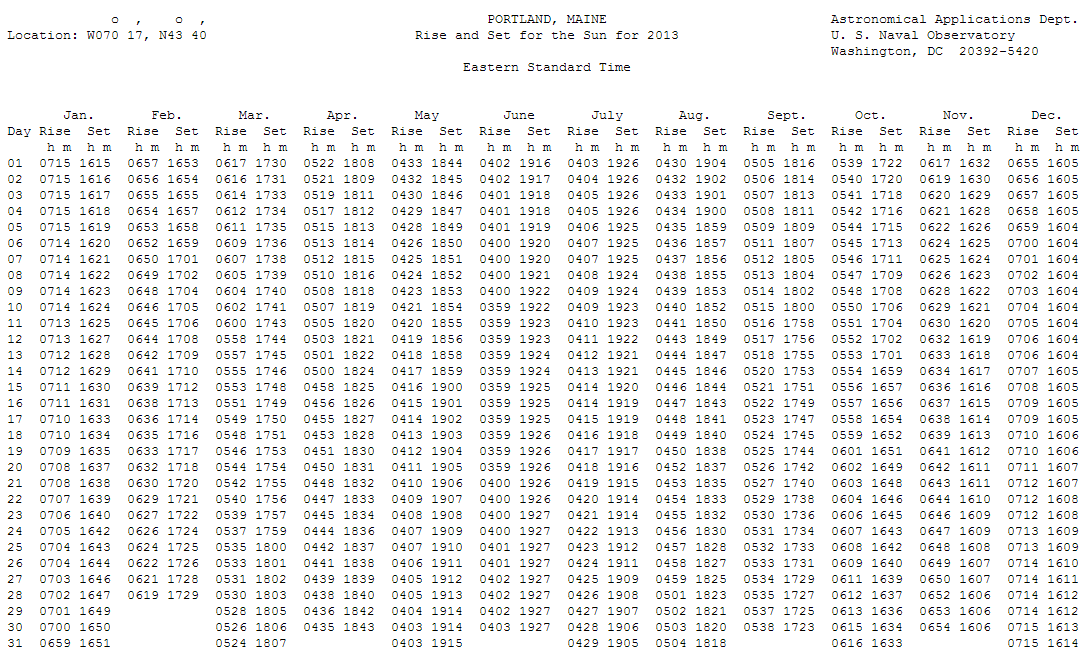
One of my favorite open-ended/rich problems comes at the end of a unit on trigonometric functions. After exploring, transforming, and applying trig functions to Ferris wheels, tides, pendulums, sound waves, … I assess my students’ understanding by giving them some almanac data of  sunrise and sunset times for a specific location on Earth. Their job is to analyze the data and create a trig function to model either sunrise times, sunset times, or hours of daylight – their choice.

The data looks like this

and that makes it somewhat challenging for students to even begin. They are reminded that they should have “enough” data to know if the model they develop fits well. I point out that the times are given to them in hours and minutes, but that they probably want a single unit (hours or minutes after midnight). From there, they are on their own to solve the problem. Usually, they work with a partner.

In the classes that I’ve used this task with, we’ve modified the amplitude, period, and midline of the sine and cosine functions. We haven’t introduced phase shift, yet. So, there is also a reminder about selecting a convenient “Day 0” for the function they choose to model with.

What I love about this task:

  • Students are talking math, asking each other about the number of data points they should use: “Should we just pick the same day every month? Are 12 data points enough?” or “Do we just go every 20th day?” or “What should we use for the first day?”
  • Students are problem solving. They have to convert the times into a single unit. They have to make decisions about which variable to model, when to start, which type of model to use. Then, they can collect the relevant information to modify their chosen function.
  • Students are using technology. Although they don’t have to, it’s really easiest to have the kids making scatterplots on calculators or computers and then graphing their model on top of that. Then they have a built in way to check their work – they don’t have to ask me (the teacher) if they are correct. It shows up in the picture that they create.
  • Students think that working with trig models is really hard, so they feel very proud when they are able to complete this task without any help from the teacher.
  • It’s really easy to grade. Either the model fits or it doesn’t. Kids turn in their data tables and work showing how they calculated the necessary values for their model. This precludes anyone from using the old SinReg command.
  • Even though I’ve used this task for about ten years, it’s a perfect fit with the Common Core math standards (trigonometric functions) and practices. And since I live in a SBG world, this is a very good thing.

My favorite kind of assessment is one where students have to apply what they’ve learned to a different situation. Even though we create lots of different trig models in class, sunrise, sunset, and daylight hours represent a new application. And a new challenge.

4 Comments

Filed under MTBoS Challenge, problem solving, technology

Week Two @ Baxter Academy

Wow. What a week. We had our first week of classes and our first Flex Friday.

Our schedule is an interesting mix of current tradition and pushing the envelope. The students have eight classes and there are no study halls. There are four classes every day, so the days alternate. Classes meet either Monday & Wednesday or Tuesday & Thursday. So, during this past week, I met all of my students twice. I am teaching seven classes this year. Yes, seven of eight blocks. It’s a lot. But it’s what’s necessary during this first year. So we are all doing what’s necessary. I am teaching all of the 9th graders and 2/3 of the 10th graders. That gives me about 105 students, which averages to about 15 per class. Not bad, really. I just wish I had a little more time to chat with colleagues. I’m hopeful that will come.

So what did we do this week?

9th grade

We had a bit of fun with Dan Meyer’s Pyramid of Pennies problem. After watching the video a couple of times, I had them write down the first question that came to mind (and then a couple more). They shared their questions with each other and with me. Many questions were common from class to class, but some were quite different. Here’s a listing:

  • How tall is it?
  • How much does it weigh?
  • How much money is it?
  • How did they keep the pennies from falling?
  • How many pennies is that?
  • How long did it take?
  • Where did they get the pennies?
  • How many pies can you buy with all those pennies?
  • How many pennies are in each row?
  • Why a pyramid?
  • How many people did it take to build?
  • How old were the creators?
  • What’s the oldest penny?
  • Why time lapse instead of sped up video?
  • Were there any patterns to the penny placement?
  • Are they real pennies?
  • Who has that much time?
  • Is the change between each layer a constant?
  • What did they do with the pennies afterwards?

As they set out to figure out how many pennies were in the completed pyramid, I heard lots of great discussion about how the layers were formed. If the bottom layer was 40 stacks by 40 stacks, then was then next layer up 38 by 38 or 39 by 39? If there were 1600 stack in the bottom layer, then did the next layer up have 1596 because it lost four stacks from the corners? Each team made some assumptions and then proceeded with their computations from there. Several teams were able to see their plans through, making some adjustments if the numbers didn’t seem to be making sense. Other teams ran out of time. But that was okay. They had done enough to share strategies. I especially liked that when one group said, “We multiplied 40 x 40 x 13 to get the number of pennies in the bottom layer, then we did 39 x 39 x 13 to get the next layer, then 38 x 38 x 13, and so on. Then we added up all the layers to get the total,” another group said, “We did the same thing. We just multiplied by 13 at the end.” Huh? How can it be the same if you multiplied by 13 at a different time, I asked. The response: “They found the number of pennies in each layer. We found the number of stacks in the pyramid and then multiplied by 13 to get the number of pennies.” Isn’t that beautiful?

On the second day of class (Wednesday/Thursday) we played around a bit more with the patterns of pennies. Since just about every group had focused on squaring numbers to figure out how many pennies were in each layer, I asked them to take a look at these numbers: 1, 4, 9, 16, 25, … and describe any patterns they discovered. Looking for and describing patterns is key to thinking critically about mathematics (as well as lots of other things). Most groups found the difference pattern. At least one group in each class found a pattern by looking at the final digit of each square number. Interestingly, no groups attempted to represent these numbers visually. I guess we’ll have to go back to that. They were also able to tell me that the number of stack on layer n would be  n^2. (Maybe someone can teach me how to show this properly using latex. I tried and tried and couldn’t get it to work.)

Then I gave them this pattern: 1, 5, 14, 30, 55, 91, 140, … and asked them to find the next few numbers in the sequence. Again, this involves looking for patterns. I also challenged them to come up with a formula, suspecting that they would not be able to. They’re 9th graders, after all. I’m happy to say that nobody gave up. They really tried to come up with a formula. They were thinking recursively, of course, but don’t yet have any language for that. Again, that’s okay. I found out a lot about these students during those two classes.

10th grade

Again, I turned to Dan Meyer. But this time we tried out the Penny Circle. It was really the first time I’d ever asked my students to do math through an online guided activity. I’d been through it myself, first, and it seemed pretty straight-forward and reasonable. And while the conversations during class were all good, the data that I received on the back end (teacher dashboard) was not so helpful. It’s not any fault of what Dan & Desmos put together. I love what they put together. I just forgot that I would be using it with 10th grade boys. (Yes, most of our 10th graders are boys – there are only a handful of girls in the 10th grade.) So, I got some very silly, anonymous results. Thankfully, nothing was school inappropriate!

However, it’s now difficult for me to use their data to figure out who needs some help understanding the relationship between diameter and area of a circle. Although the easy answer is: most of them. I’m not sure that this new presentation of the original problem prompted creative problem-solving and curiosity in the way that the penny pyramid problem did for the 9th graders. Maybe that wasn’t the point. But part of me wishes that I had given them some real pennies and real circles and had them collect the data that way. These kids didn’t have the opportunity to think about their own questions after watching the video. I’m just not sure their curiosity was sparked.

I’ll keep working at it. I know that I can spark some curiosity around math for this group. But they will be a bit tougher than the 9th graders. I have my work cut out for me.

Flex Friday

One of the founding principles of Baxter Academy is that students work on projects. Big projects. Long term projects. Meaningful projects. To give kids time to work on these big, long term, meaningful projects we have Flex Friday. We have no regular classes on Friday. Instead, the time is devoted to project work (mostly). Since it was our first Friday and students do not yet have projects to work on, we teachers gave some presentations of possible projects. The ideas ranged from building a noise & dust containment system for our CNC router, to figuring out the best possible lunch program for our school, to building a greenhouse, to designing a video game, to researching the ethnomusicology of Maine. Some students have their own ideas that they are hoping to pursue this year, but the rest now have lots of good ideas to choose from.

Since we have this gift of Flex Friday time, we also thought that it would be good to get out and about into Portland. We are only a couple of blocks from the Old Port, after all. So, on Friday afternoon groups of kids with their advisors went to different locations around town. I was with the group the went to the Portland Public Library. They’ve had a recent renovation and the new building is awesome. Bright and inviting, this is a place where I would not mind spending an afternoon. We signed all the kids up for library cards – I got one, too. The little city of Portland has a great library full of wonderful resources. I can’t wait to begin exploring them all. Now, to find the time …
2 Comments

Filed under Baxter

Week One, Two First Days

It was an absolutely beautiful day.

It was an absolutely beautiful day.

We (the faculty at Baxter Academy) decided that we actually have three 1st days of school this year. Nathaniel called them 1D1, 2D1, and 3D1. The names stuck.

1D1

On 1D1, we all gathered at Fort Williams Park in Cape Elizabeth. This beautiful seaside setting was the backdrop of our work for the day. The school contracted with Rippleffect whose fabulous staff designed a series of five challenges for the kids and faculty.

Clumping and acting seemed to be the key.

Clumping and acting seemed to be the key.

One challenge was called, “Where’s my water bottle?” Similar to the old red light, green light game, this time the kids had to figure out how to grab said water bottle, return to the starting line, and let everyone have a chance to hold it, all while making sure that Toby, the Rippleffect guide, did not see them moving or guess who was holding the water bottle. It was interesting to see them devise a plan that completely fooled Toby. It turns out that Toby was a student in the first year of the Francis W Parker Charter Essential School, the charter school in Massachusetts founded by Ted and Nancy Sizer. It was an interesting side note for me – during my first year of teaching, I met Ted Sizer during a Coalition of Essential Schools function and read his book, Horace’s Compromise. He made a tremendous impact on the direction my teaching ultimately took.

It quickly became a salvage operation.

It quickly became a salvage operation.

In a different challenge, the group was divided into four engineering/design teams. Their task was to design, build, and market a raft from three pieces of float foam, three 6 foot long 2×4 pieces of wood, and three lengths of rope. The ultimate test, of course, was to take them on the water to see how far they could go (and how quickly they would fall apart). There were some solid designs in my group. Unfortunately, the construction process didn’t go as well as planned. All four rafts fell apart in the water. Kudos to the kids who volunteered to test the rafts. Sure, it’s September and the weather was beautiful. But this is still Maine – that water isn’t very warm.

It was a fabulous first day. Lots of laughs, smiles, and new friends.

2D1

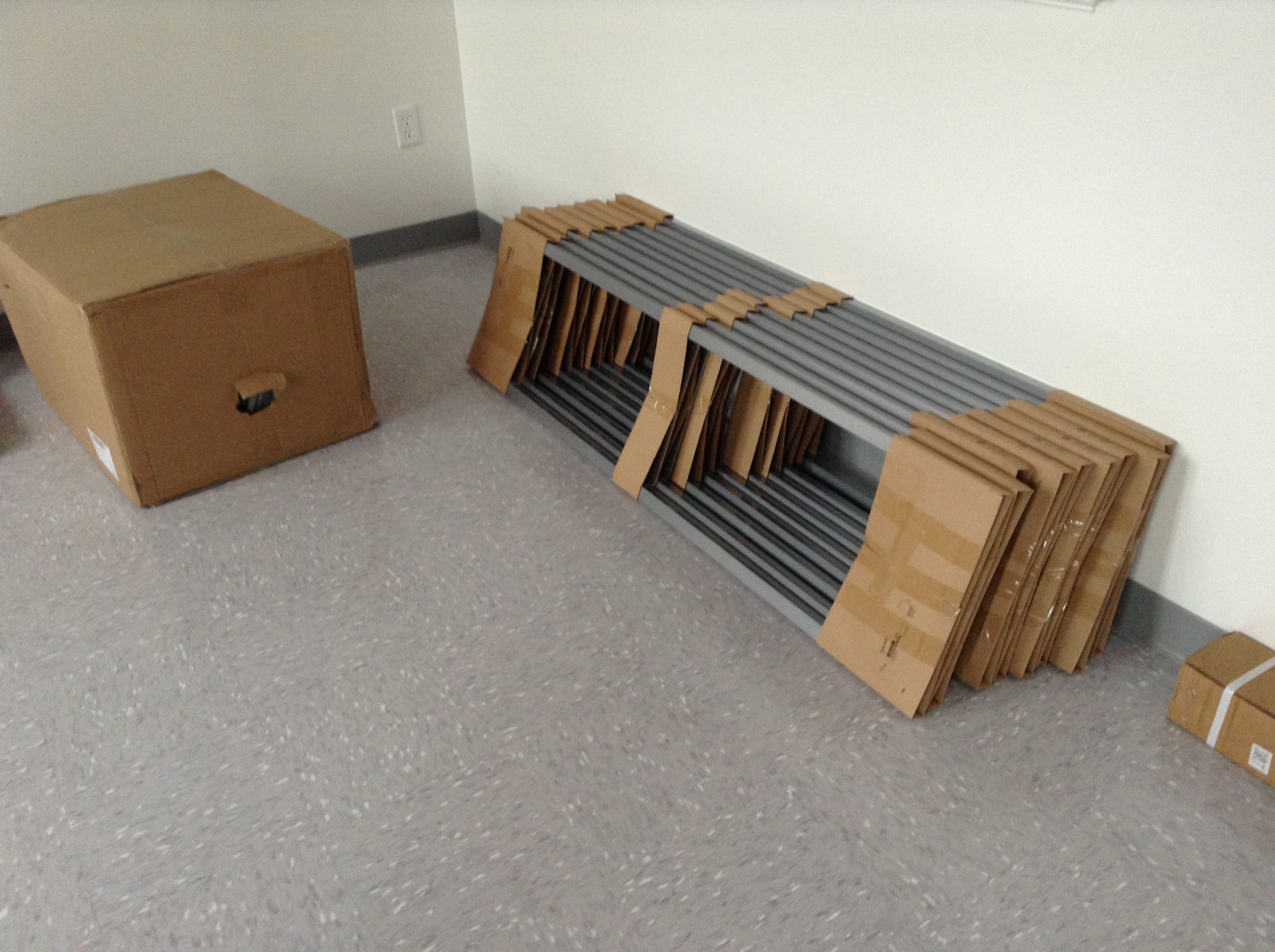
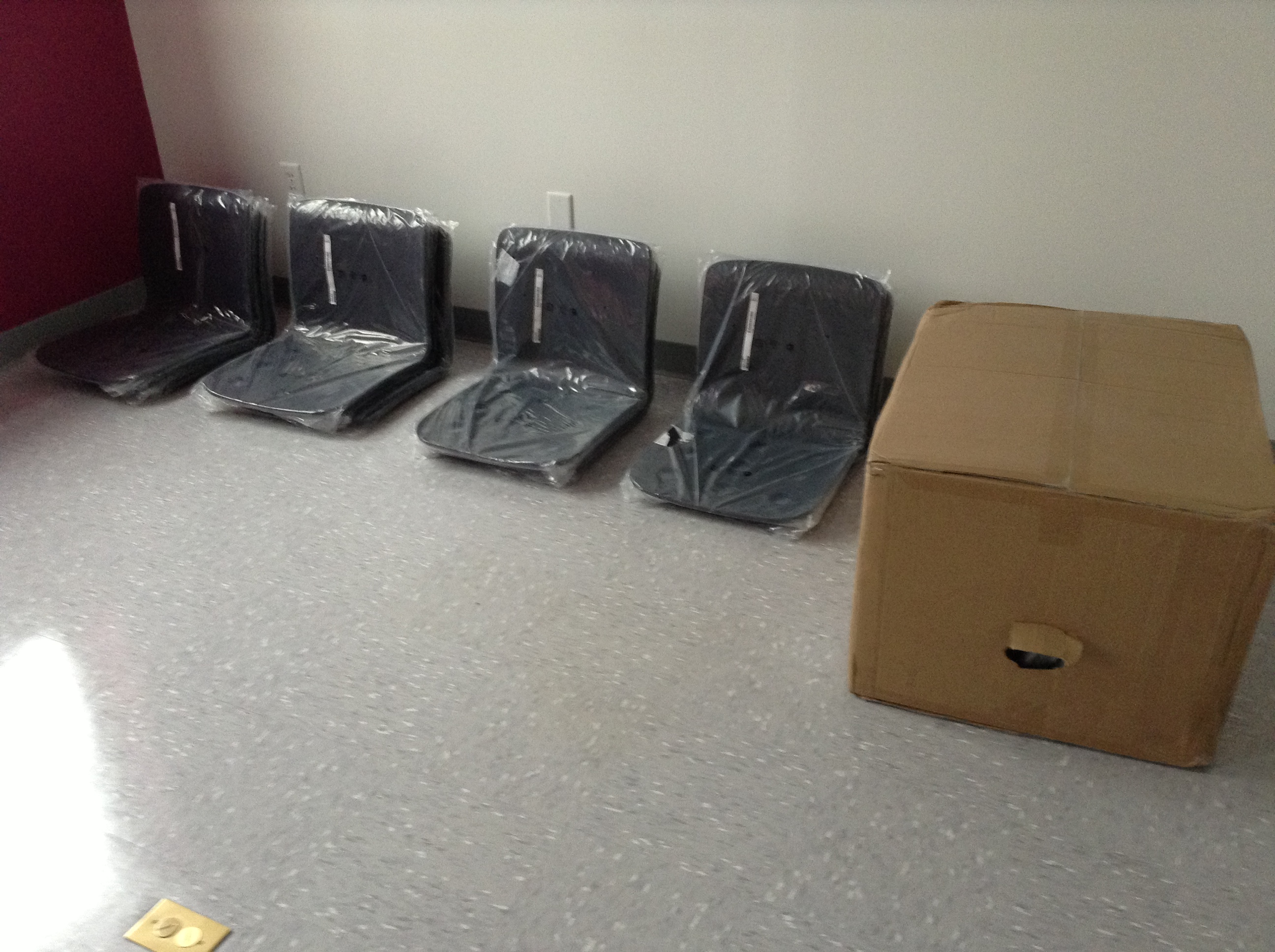
Our second first day was at the school. As students entered the front doors to wild applause and noise making, a reporter from Maine Public Broadcasting caught the racket from outside. He was later allowed to enter the building and speak with a couple of teachers. Here’s the report. Quite nice, actually, considering some of the turmoil that has surrounded the opening of this school. Once the opening ceremonies were over, we got down to business: building furniture and arranging our rooms. We had about 7000 pounds of tables, chairs, cabinets, and bookshelves to assemble. Computers needed to be set up in the lab. Off we went in our advisory groups and got to work. My classroom started out looking like this:

IMG_0301 IMG_0302 IMG_0303

A few hours later it looked like this:

IMG_0352

And the view out my window?

IMG_0298

IMG_0299

Sure, there’s a hotel under construction and a lumber yard next door (they own the building, after all). But there’s also water. I’ve missed the water. It’s good to be home again.

Stay tuned for 3D1 – that happens on Monday – and I get to teach some classes!

2 Comments

Filed under Baxter