A Visit from the Charter Commission

Baxter Academy is a charter school in Maine. We are independent, meaning that we are not “owned” by some education company and we are not “aligned” to any particular program that already exists. We create our curriculum, our courses, and our materials. We answer to our students & their parents, to each other, to our Board of Directors, and to the Charter Commission.

Each year, at the end of the year, we get a visit from the Charter Commission. Well, it’s happened for the past two years – I imagine that they intend to continue this practice. The visit is kind of like a cross between an IRS audit and a NEASC accreditation visit. This year the Commission decided to take about 45 minutes in the middle of the day to split up and have conversations with different groups: students, teachers, parents, and community members. At other times they met with administration and the Board. At the end of the day, they gave some feedback to our Head of School:

They reported excited students and satisfied parents. They shared with us, at the end of the day, that teachers reported a strong sense of community, that Flex Friday is great, that special ed students are thriving, but that we need more time to communicate with parents around proficiency based diplomas. Teachers also liked working in start up mode, even though it is hard. Students liked best: the community, being able to connect inside school learning with outside the school, their control of their own learning, choosing their own curriculum, that teachers are guides, that they can challenge teachers respectfully and get answers. They report very little bullying and a culture of kids sticking up for one another.  If they could change one thing it would be to have more space, to add sports, more balanced m/f ratio, more clarity around grading.

“You can tell after even 2 minutes in the building that this is a great school environment.”

Clearly there is more work to do, but getting good feedback at the end of the year makes the rest of the hard work all worth it.

Leave a comment

Filed under Baxter

Why Standardize Normal Distributions

The new trimester started on Monday and I’m teaching a class called “Designing Experiments and Studies.” It’s a statistics class, so we’re starting with a bit about normal distributions. Most of the students in the class are juniors, but they’ve had very little instruction in statistics. They didn’t get it from me last year, so any knowledge that they might have is probably from middle school.

Today, I posed this question:

baby weights

And then I gave them some time to work it out. Here’s what happened in the class discussions (a bit condensed – the actual discussions took about 15 minutes in each class):

S1: The boy would weigh more compared to other boys because the boy is 0.25 pounds away from being one standard deviation above the mean, while the girl is 0.5 pounds away from being one standard deviation above the mean. Since the boy is closer to being one standard deviation above the mean, the boy weighs more, compared to other boys.

S2: But, 0.25 lbs for the boys is not really comparable to 0.5 lbs for girls because the standard deviations are different. I agree that the boy weighs more, but it’s because the boy is about 92% of the way to being one standard deviation above the mean, while the girl is only 75% of the way to being one standard deviation above the mean.

S1: What does that matter?

S3: It’s like if you’re getting close to leveling up (I know this sounds really geeky), but if you’re 10 points away from leveling up on a 1000 point scale, you’re a lot closer than if you’re 10 points away from leveling up on a 15 point scale. Even though you’re still ten points away, you’re a lot closer on that 1000 point scale.

S4: But you’re comparing boys to boys and girls to girls. You’re not comparing boys to girls.

S2: Yes, you actually do have to compare boys to girls, in the end, to know who weighs more for their own group.

Me: How did you figure out that the boy was 92% of the way to being one standard deviation above?

S2: Well, the boy is 2.75 lbs more than the mean weight and 2.75 / 3.0 is about .92. I did the same thing with the girl and got 75%.

At this point I showed them a table of z-scores, kind of like this one and we talked about percentiles. Looking at the table, they determined that the boy was at about the 82nd percentile, while the girl was at about the 77th percentile. Therefore, the boy weighed more, compared to other boys, than the girl weighed, compared to other girls.

I have two sections of this class, and this recreation of the conversation happened in both classes. I’m so happy when my students make sense of mathematics and reason through problems. I never had to tell them the formula to figure out a z-score, or why that might be useful or necessary. They came up with it.

3 Comments

Filed under problem solving, teaching

Order of Operations and Facebook

I received this text from my brother: Pam, who created the “Order of Operations” rule? Well, that’s a curious question. Why is he asking? I’d never thought about who “created” these rules. They just kind of made sense to me. Before I did any research, I thought for myself why these rules made sense to me. Here’s my response to my brother.

Suppose I needed to calculate 4 + 3 * 5. Without the order of operations, I would just make each calculation as I come to it. In this case 4 + 3 = 7 and 7 * 5 = 35. But, 4 + 3 * 5 is equivalent to 3 * 5 + 4, right? Because of the commutative property of addition, the order that we add numbers in doesn’t matter – we get the same result either way. So if that’s true that 4 + 3 * 5 = 3 * 5 + 4, then both calculations should give us the same result. But, if we don’t have conventions around this then the second expression, 3 * 5 + 4, would result in 19. Clearly that’s not equivalent to 35.

So why would we choose to multiply first instead of adding? We can think of the expression above (4 + 3 * 5) to mean that I am adding 4 onto 3 bunches of 5. I guess I think that it’s kind of implied that I would want to know what 3 bunches of 5 are before I add 4 onto that number. That’s why we would multiply before we would add.

There is a similar argument to be made with division. Suppose I come across 3 + 1/2. Without our order of operations, we might conclude that this was equivalent to 4/2 (or 2). But isn’t 3 + 1/2 the same as 3 and a half, or 7/2 (which is clearly not the same thing as 2)?

The PEMDAS mnemonic is a little misleading, too. It suggests that multiplication takes precedence over division and that addition takes precedence over subtraction. That’s not true. Multiplication and division are at the same level as are addition and subtraction. For example, if you want to calculate 6 * 3 / 2, you can first calculate 6 / 2 and then multiply that result by 3. Or, you can calculate 6 * 3 and then divide that result by 2. Either way, you end up with a result of 9. You can reason similarly with addition and subtraction.

Personally, I think that the real question is “Who invented parentheses?” I mean, to show grouping by using symbols is just genius. That would change the outcome of the original expression, right? (4 + 3) * 5 is very different from 4 + (3 * 5). At some point, mathematicians agreed that they didn’t need to write the parentheses around 3 * 5 (maybe for the reason that I stated above, maybe not), but that they would need to explicitly group (4 + 3) if that’s what they meant.

My Google search found this response to your question from Ask Dr Math.

Turns out there’s this Facebook post that asks you to calculate 6+1*0+2/2. Some people say the result is 7 and others say it is 1. Which is correct? That’s where the order of operations comes in. And that’s what was behind my brother’s question.

4 Comments

Filed under randomness

A few of my favorite things

Following the lead of the good folks over at One Good Thing, I’m sharing a couple of fun tidbits from my life at school this week.

Today a student came to ask for help with a trig problem he had. He’s part of a team building a 3D printer and stand and he needed to figure out how long to make a brace of some kind. (I don’t really know exactly what his team is working on, but that’s the gist.) He had everything set up properly, but it wasn’t making any sense to him. Turns out, his calculator was set to radian mode. Yay that he recognized that something was wrong. Yay that he asked for help. Yay that he knew what he was doing.

One of our math classes this term is called Euclidean Geometry & Introduction to Logic. The teacher (not me) has been focusing on precise communication of reasoning. The other day I observed a student in my advisory ask for some peer feedback on a proof. The first student he asked had been out sick for two days, so he very kindly declined. Then next student, also a member of my advisory, gave very solid and constructive feedback about how the proof could be improved. I love it when they talk math with each other.

My Introduction to Stats class was dealing with correlation vs causation this week. They were presented with these two variables: time in seconds spent draining a full bathtub, water depth in cm, and asked to identify the explanatory and response variables. Some students saw the draining time as the explanatory variable and others saw the size of the bathtub as the explanatory variable. The debate that ensued was engaging, animated, and enlightening. Plus, I was able to unleash the voice of a 9th grade girl who has been afraid to speak about math before that moment. Another student commented on her way out of class, “I’ve never had such an argument about bathtubs before!” I love it when we can respectfully disagree and have interesting conversations.

Leave a comment

Filed under Baxter, teaching

Baxter Academy Shadow Day

Yesterday was a “Shadow Day” at Baxter Academy. That means that most of our students were off on a job shadow of their choosing. I’m anxious to hear about the shadows that they were able to arrange during the snowiest week of the winter, so far. I would have checked in today, but we have another snow day – the third this week.

Anyway, while our students were off doing their shadows, we had about 120 prospective students, interested in attending Baxter Academy next year, join us for a “simulated day.” The students were placed into 16 different groups, each led by a couple of current Baxter students through a day of classes that included a math class or two, a science class or two, humanities, and an elective or two.

I co-taught our modeling class with one of our science teachers. This is the introductory math & science class at Baxter. It’s technically two sections, but they are integrated and teamed up so that the two teachers are working with the same groups of students. Sometimes we meet separately, as a math class and a science class, and sometimes we meet together. I’ve written about the class before, and the kinds of modeling we have made them do.

But what do you do with a bunch of 8th graders who are are with you for only an hour? Introduce them to problem solving through with this TED talk by Randall Munroe. And then take a page from Dan Meyer’s Three Act problems – a page from your own back yard: Neptune*. A brief launch of the problem and off they went. Not every group was able to answer both parts of the question: How big is the Earth model and where is it located? But most groups were able to come up with a solution to at least one part.

The point of the day was to provide a realistic experience of what it’s like to be a Baxter student. We grouped them together with others they didn’t know before walking into the building. We asked them to collaborate to solve a problem they’d never seen before. We asked them to do math without giving them directions for a specific procedure to follow. We asked them to share their results in front of strangers. We gave them an authentic Baxter experience.

*For more information about the Maine Solar System Model, visit their website. It’s really a rather amazing trip along this remote section of US Route 1. I’ve done it – I’ve driven through the solar system.

Leave a comment

Filed under Baxter, problem solving, teaching

The Frozen Code – A Classroom Example

I could have kicked myself when I saw Dan Meyer’s post about Gelato Fiasco‘s Frozen Code. I mean, they are literally just blocks away from my school. I didn’t use Dan’s map to launch the problem (Gelato Fisaco only has two actual stores), but just dove into the main idea that he posed. Here’s the prompt.

I have a bunch of students, mostly 9th graders, in a class called Functions for Modeling. So today I gave them the challenge of finding a function rule for the Frozen Code. We started by assuming that the gelato that they purchase would cost $5.00. One class came up with three different rules:

IMG_1074The blue group originally had just the middle rule: P(T) = 0.05T + 3.40. Students in both classes were eager to point out that the rule only applies if the temperature drops below 32 degrees Fahrenheit, and they wanted to somehow make that clear in the function rule. So we started to add to the definition. Then someone pointed out that there would be a bottom limit to the discount, too. After all, Gelato Fiasco might be willing to give you gelato for free if you are that willing to venture out into the extreme cold and they are still open, but they are unlikely to pay you to come in. So we added the third bit about temperatures below -68 degrees Fahrenheit.

What I love about the above work is that before we got into all the piecewise stuff, I was able to ask them, “How do we know if these three function rules are equivalent?” They told me that they “generated the same results,” that they could “use algebra to change from one to another,” and that they “would all produce the same linear graph.” How cool is that? We were also able to discuss how one form easily told us the price (of a $5 gelato) when the temperature was 0 degree F and another form showed us all the calculations clearly.

But they weren’t satisfied. After all, every gelato purchase isn’t going to cost $5 – price is also a variable. So that’s how we got into functions that have two independent variables. I asked them to modify their rules to reflect this new information. Here’s what they did:

IMG_1073

Once again I asked if these were equivalent and how they knew. We wondered what the graph would look like. Would it be flat or curvy?

We’ll check that out tomorrow.

[Update: Here are the graphs comparing the set price of $5 to the variable price model.]

gelato models

By the way, my students think this is a pretty good marketing strategy – you are fairly likely to get some kind of discount for buying gelato in the dead of winter, but not that big a discount, on average. Last Thursday would have been a great day, though. The temperature was -10 after the sun set.

1 Comment

Filed under Uncategorized

A Very Baxter-y Day

Today was our first real day of intersession. Okay, we had one day of intersession last year, at the beginning of April, and it went pretty well. But, this week is a whole intersession plan. The theme of the week is “community.” We are still building this school, we’re barely into year two, and finding our identity. The focus for today was “community inside” meaning inside the building, among ourselves. We had time to work on digital portfolios – the kids have student-led conferences on Thursday and have lots to prepare. As they were working together in our advisory, there was lots of sharing and supporting of each other. I am lucky to be advisor to such a kind group of students.

We had a round of what we’re calling “mixers” because we’re able to have a structured discussion across grade levels and break down those walls. The mixer was facilitated by student senators and focused on academic challenge and rigor. What do we want our school to be? Do we want to be challenged in class? What is the student responsibility regarding challenge and school work? It was interesting to hear the students talk about an idealized view of the “perfect” student: hard-working, organized, focused, driven. It wasn’t presented to them that way, but that’s how they responded. At the end of the discussion, I asked how many of them achieved that ideal, and got a lot of “um, well.” Frankly, I doubt that I could achieve the ideal that they set forth. But sometimes, I think that teachers do expect that ideal student to land in front of them every day.

After lunch, we relaxed with a community dessert and an open mic session at a hall nearby, where we could all fit comfortably and enjoy each other’s company. Students and faculty performed. We heard from lots of different groups, from storytelling to spoken word to musical talent. I’ve had my time performing on stage, and know how nerve-wracking it can be. But it’s easier to get up in front of a group of strangers than it is to perform for your peers and colleagues and students. My colleagues and students were very courageous and very supportive of each other today.

And that’s how we build community.

Leave a comment

Filed under Baxter

Modeling Projectiles

My Functions for Modeling classes are ending on Tuesday. These are the introductory math classes at Baxter Academy. This course is paired with Modeling in Science, which has a focus on science inquiry and the physics of motion – kinematics. The final assessment is a ballistics lab, where the student groups have to measure the launch velocity of their projectile launcher and, along with some other measurements and a few guesses, identify the best launch angle and launch point to fire the projectile at a vertical target. The students are not allowed to have test shots or simulated shots. They are expected to gather the necessary data and complete all of their calculations before testing their theory with one, single shot. The target is fairly forgiving, but students are still amazed when their predictions result in a projectile going through the target.

4 Comments

Filed under Baxter, problem solving, teaching

How do you teach Project Management?

One of the founding principles of Baxter Academy is the idea that working on big, long-term projects is worthwhile. These are projects that students design, sometimes in conjunction with a faculty member, sometimes on their own. While the process worked pretty well last year, the student feedback indicated that they wanted to be held more accountable for their project proposal, for the work they did on the project, and what they were able to accomplish. So this year we ramped up the proposal process. Project teams have to write a proposal using this template and submit it to a review panel consisting of a teacher, administrator, and student senator. Almost every proposal fails to be approved on the first try, but that’s okay. The review process has made the proposals more focused and much stronger.

Since we devote every Friday to this project work, it’s important that the project teams have a clear idea of what they want to accomplish and what they need to do each week. Which begs the question, “How do you teach project management?” Gantt charts are nice, but require good guesses at tasks and completion times. I have experience teaching the critical path method, which I think it pretty cool, but again, you need to have an idea of what the tasks are and how long each task will take. And the “projects” were all hypothetical, from a textbook. Nobody was actually trying to do them. Our engineering teacher is really partial to Scrum boards. I kind of get how they work, but have a difficult time conveying their use and importance to students.

Do you just dive in and make guesses at times and adjust along the way?

1 Comment

Filed under Baxter

It’s all in how you ask the question

I teach half of an integrated math & science modeling class. On the math side, we focus on functions and a little bit of right triangle trigonometry. The science side is all about motion, one dimensional and two dimensional – hence the trigonometry. We’re now entering the final few days of the trimester, and have gotten into that 2D motion part. Did I mention that this is the introductory math/science class for 9th graders at Baxter Academy?

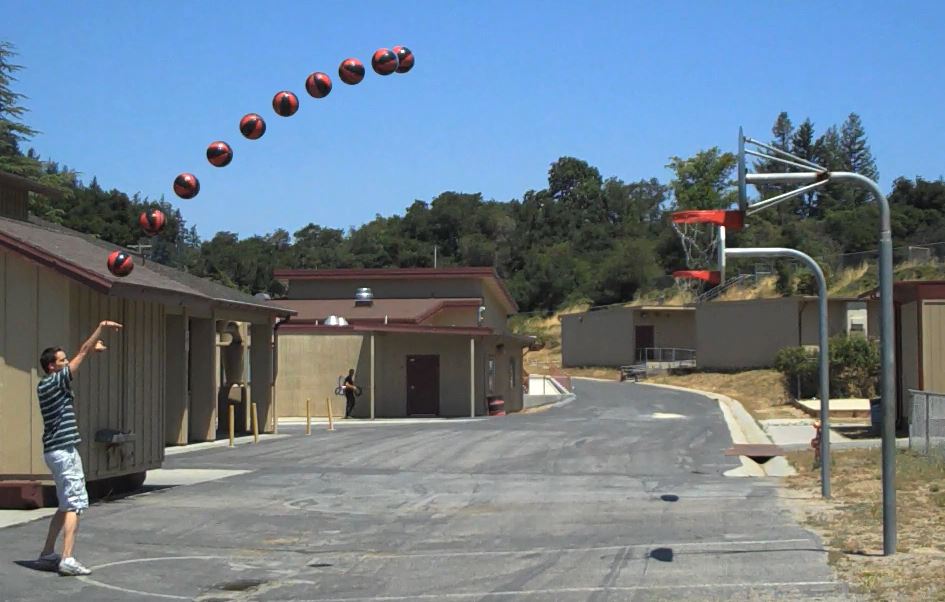
We started with Dan Meyer‘s Will It Hit the Hoop? concept, slightly modified. Showed Act 1 video, but captured this picture for analysis.

hoop shot-1

Interesting conversation begins. Many students are convinced that the ball will fall short of the hoop because “it is slowing down.” What makes them think that, I wondered. Maybe because up until this point, the conversation in science has been about constant velocity motion, in one dimension. Showed Act 3 of course and those who were sure the ball would go in were vindicated. But their comments still nagged at me. Maybe they just need more experiences – this was, after all, just the first day of 2D motion.

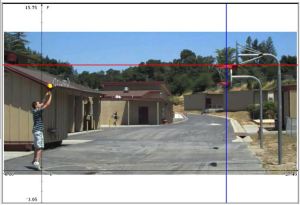
We watched part of an episode of Mythbusters, the one where they fire a bullet and drop a bullet and have them land in the same spot at the same time. It’s really a good episode. It really helps to drive home the fact that the forward motion of the bullet has nothing to do with how much time it takes to fall to the ground. It means that horizontal and vertical motion can be thought of, and modeled, independently of each other. On the science side of things they had developed the kinematics model: z(t)=\frac{1}{2}at^2+v_0t+z_0. So then we adapted that model for horizontal and vertical motion. We went back to the basketball shot. Analyzing the photo against the graph, we estimated the the initial position of the ball is at (1, 8) and the final position of the ball would be (19.75, 10). We also figured that the ball was in the air for about 1.8 seconds. From this information my students calculated the initial horizontal and initial vertical velocities to be 10.4 ft/s and 30 ft/s, respectively.

hoop shot


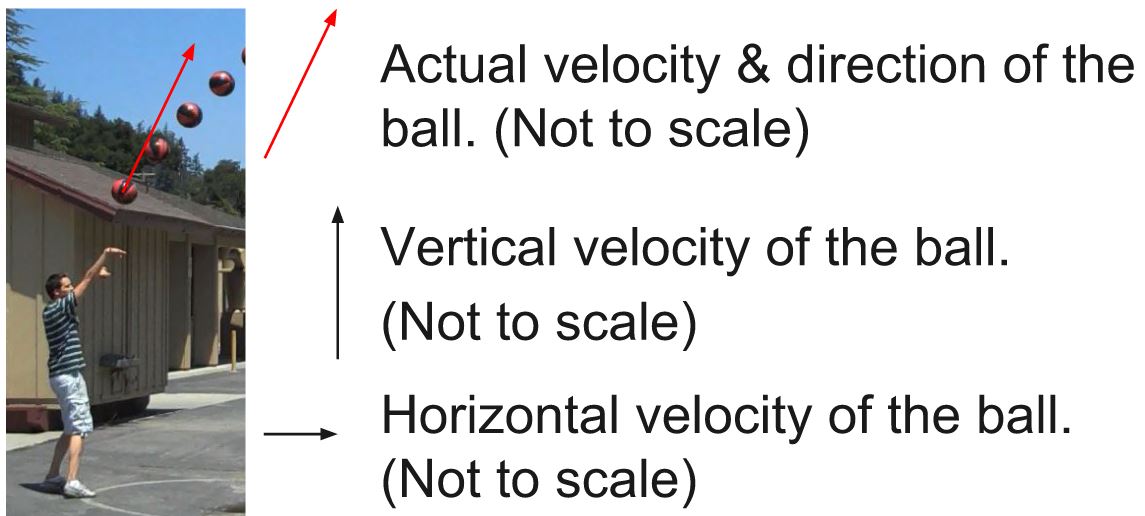
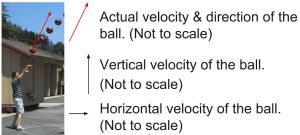
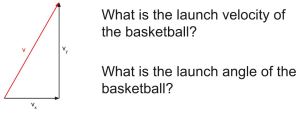
But Dan did not throw the ball only horizontally or only vertically. He threw it at an angle – so that it could reach the hoop, presumably. So I asked the question: “What was the launch velocity of the basketball?” and accompanied the question with this image:
hoop shot 2


Class was over, so I left them to work that out for homework.

Next day, I had them check in with each other and then asked, “How did you think about this problem?” Overwhelmingly, they agreed that the launch velocity must be the average of the horizontal and vertical velocities. This happened with both groups.  I asked them why they thought it should be the average. I asked if they thought the launch velocity should be greater than 30 ft/s, between 10.4 ft/s and 30 ft/s, or less than 10.4 ft/s. They were convinced that the launch velocity should be somewhere between 10.4 ft/s and 30 ft/s. Some thought that it should be closer to 30 ft/s since the ball is “going more up than over,” but that it would still be less than 30 ft/s.

A student in one of the classes convinced that group that it couldn’t be the average with the following reasoning: Suppose that the ball was thrown straight up. That means that the vertical velocity is 30 ft/s and the horizontal velocity is 0 ft/s. If the launch velocity is the average, then that would be 15 ft/s, but we know that the launch velocity is 30 ft/s. So it can’t be the average! So, of course I asked, “Then what could it be?” And they went with the idea that it must be the sum of the two velocities. But that would give us a launch velocity greater than 30 ft/s. We talked about this for a few minutes. They weren’t sure.

Then I showed them this picture:
hoop shot 3


Only after seeing this picture did they make any connection to a right triangle, or Pythagorean Theorem, or trigonometry. It had taken the better part of an hour to arrive at this conclusion, and then it took only 5 minutes to find the solution.

What would have happened if I had jumped directly to the right triangle representation? They would have had a quick solution, but they wouldn’t have had the opportunity to think about whether or not the launch velocity is the average of the horizontal and vertical. Maybe you think it was a waste of class time to allow my students to engage in such discussion. Maybe it was, but I don’t think so. My students had to take some time to construct meaning. They had to confront their misconception and convince themselves and each other that taking the average didn’t make sense. Sure, I could have told them, it would have been more efficient, but would that really have helped their understanding?

2 Comments

Filed under Baxter, problem solving